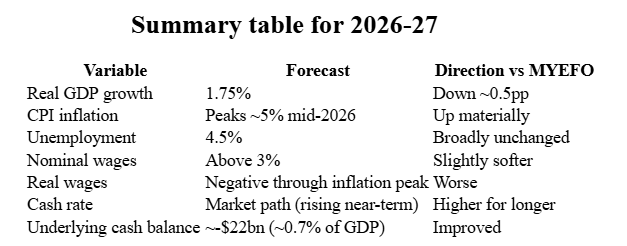





















You’re probably sick of the wall-to-wall budget analysis so I’ve kept my snapshot short and sweet:
The next 12 months will continue to be tough for Australian households. The cost of living crisis will continue, wages won’t keep pace with inflation, interest rates will stay higher for longer and while the economy will slow, it won’t dip into economic recession.
But our jobs are secure.
That’s the helicopter view of your financial life over the next 12 months from the federal budget.
While it bombards us with data and new policies, the budget is simply a blueprint for your financial life over the next year. And it doesn’t appear that things are going to improve financially anytime soon.
Economic growth will slow to a meagre 1.75 per cent next financial year before it improves to a more normal 2.5 per cent the year after.
Here’s a snapshot:
Your job
Unemployment has remained impressively low over recent years as job creation has stayed strong. This is mainly because of record government spending on infrastructure and energy transition projects.
Unemployment, according to the budget forecasts, will stay around 4.5 per cent despite a slowing economy.
Nominal wages growth is expected to remain above 3 per cent, and annual real wage growth will return from next year, after growing for eight of the last nine quarters.
But with inflation peaking at 5 per cent and nominal wages above 3 per cent, real wages will go backwards through the peak inflation period before turning positive again from 2027.
Your family budget
Real wages are expected to decline through the peak inflation period before turning positive again from 2027. Petrol relief is also temporary, with the 26.3 cents-per-litre fuel excise cut and the reduction in the heavy vehicle road user charge both scheduled to end by July.
Income tax cuts will flow to more than 13 million workers, with the 16 per cent tax bracket reducing to 15 per cent from 1 July — delivering an average tax cut of around $50 per week compared with 2023–24. The new $1,000 instant tax deduction, which does not require receipts, is expected to save 6.2 million taxpayers an average of $205. Energy rebates of $150 for households will also continue.
With the RBA likely to tighten further as inflation peaks before cuts resume from 2027, variable mortgage costs are expected to rise before falling. This burden will be felt disproportionately by younger households.
Overall, lower and middle-income working households will be modestly better off through tax cuts, while mortgage holders and families affected by NDIS changes will be worse off. Aspiring home buyers, however, may be structurally better positioned.
Your house
The budget doesn’t publish a headline dwelling price forecast (Treasury rarely does), but the relevant supply assumptions are:
65,000 additional new homes over the decade are expected to be enabled through the $2 billion enabling infrastructure fund, on top of the existing 1.2 million homes target.
75,000 Australians estimated to be helped into home ownership via the CGT and negative gearing changes (Treasury modelling).
Construction of government-built homes is expected to commence from 2026–27 under the Housing Australia Future Fund pipeline.
The bigger story for house prices is the demand-side tax reform: replacing the 50 per cent CGT discount with indexation, limiting negative gearing to new builds, and introducing a 30 per cent minimum CGT rate.
These changes are prospective from July 2027 with grandfathering, so the near-term price impact in 2026–27 is likely modest, although expectation effects on investor demand could be material from the time of announcement.
Your small business
The package is genuinely supportive and represents the most coherent small business measures in years.
Permanent measures:
$20,000 instant asset write-off made permanent (removing the annual uncertainty that has plagued planning since 2015).
More dynamic tax instalments (cashflow-friendly).
Simpler tax-time compliance, saving an estimated 376,000 hours annually across the sector.