





















Property investment is no longer just about residential property. With housing yields tightening, tax reforms reducing the appeal of residential investing, and affordability pressures continuing to bite, more investors are looking beyond traditional bricks and mortar.
Investing in commercial real estate — which can offer stronger returns, longer leases, greater diversification, and yes, negative gearing — is becoming increasingly popular … along with a strategy called “sector shuffling”.
This is where money is moved out of weaker property sectors and into those performing more strongly. It’s not a “set and forget” style of investing, but more a fluid, “move with the markets” approach.
I spoke with Vanessa Rader, Head of Research at Ray White Commercial, about the shift to commercial, the pros and cons of sector shuffling and what investors need to know.
Commercial appeal
Residential property might dominate headlines in Australia, but it’s far from the only property market.
Commercial property covers a surprisingly broad mix of asset classes — from industrial warehouses, retail centres and office space, through to niche sectors like fast food, childcare and medical centres.
Vanessa feels a sector shuffle is already taking place right now after the recent federal budget.
“Investors who previously used residential property as their primary wealth-building vehicle may find the commercial sector increasingly worth examining as the tax settings around residential tighten,” she explains.
Commercial property is unique in that each asset class comes with its own risk profile, growth cycle and income potential. When it comes to investing, that sort of diversity really matters.
“Diversifying investment portfolios is important to spread risk,” confirms Vanessa, who says sector shuffling plays directly into this thinking.
Property poker
Having some commercial property ‘cards’ in your hand when playing what I call “property poker” means you’re not relying on a single asset class to do all the heavy lifting — so knowing when to hold, fold or reshuffle often comes down to reading changing market cycles.
As Vanessa points out, we’ve witnessed this kind of investor play over the last few years.
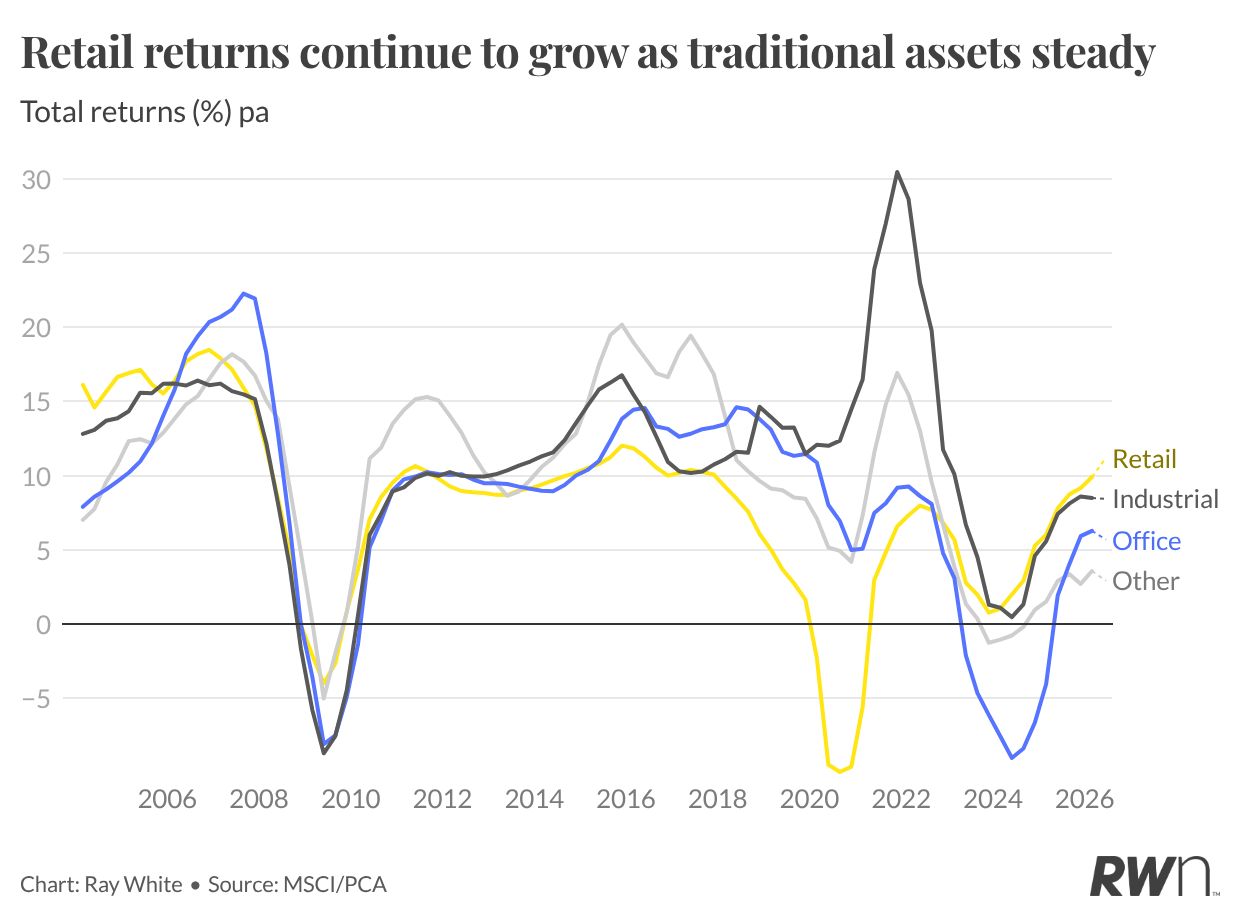
“Industrial has been one of the standout performers over the last 10 years, and prior to COVID, office was also such a key asset class,” she says. “We’ve seen this ‘shuffle’ with retail emerging as a higher-growth property type, outperforming both the more stable industrial sector and the more challenged office market.”
It’s an interesting turnaround, especially given the impact e-commerce was expected to have on the retail sector.
But according to Vanessa, that’s exactly the point: commercial asset classes all move through different cycles. What’s considered hot right now may not hold the same appeal this time next year — and investors who adapt find new opportunities.
Capitalising on commercial
Of course, commercial property’s appeal goes well beyond diversification.
“The income yields are compelling, averaging above residential yields across most commercial assets, often with long leases and sticky tenants providing income certainty that residential investment rarely matches,” Vanessa says.
According to Ray White Commercial data, average net yields in the Australian commercial sector typically sit between 5–10 per cent.
Within that, each part of the commercial landscape is telling a slightly different story:
- Retail revival: Retail has emerged as a standout performer, posting a 19.2 per cent lift in volume and delivering national total returns of more than 5.7 per cent. Sub-regional centres are leading the way within the sector.
- Industrial strength: Industrial assets remain a firm investor favourite, accounting for more than 31 per cent of transaction volumes, even as traditional warehousing activity cools.
- Office transformation: Office makes up around 19 per cent of market activity. However, a clear divide is emerging between prime CBD assets and secondary suburban offices, with the latter facing higher vacancies and increasing interest in mixed-use conversion.
- Alternative assets: Childcare centres, fast food sites, medical suites and service stations continue to attract strong demand from private investors.
While commercial property investment is very attractive to investors, Vanessa says we must always remember this:
“Higher yields are representative of higher risk.”
Do your due diligence
With this in mind, Vanessa says research is fundamental.
“It’s important that buyers do their due diligence on new asset types and understand the positives and negatives involved in these types of assets,” she says.
“Research is very important. Also speak to banks about borrowing capacity and both location and asset class. It’s important to understand the lease covenant, who pays outgoings, the cost of management, and local fundamentals such as new supply and vacancy.”
Vanessa suggests speaking with “quality agents” in the area you’re looking to invest in, and being “fully considered in their investment”, remembering that purchasing real estate — particularly commercial — is a long-term play.
“The buyer needs to look at how important cash flow is and what the long-term goal of the investment is — whether that’s lower-yielding residential with expected long-term capital gains, or quality income (which may be shorter term) with greater uncertainty surrounding capital returns.”
Be smart
My advice is always the same when it comes to investing:
Get clued up before you put your money into anything – like commercial property.
By this I mean gain knowledge from both well-known investors and everyday people in your life who act as a “money mentor” to you. Read investment books and newsletters, follow property news and credible property investors to boost your knowledge.
You can never be too informed when playing property poker.