





















It was a big win for Labor at the election, but how will their policies impact the property market? Let’s take a good hard look.
When it comes to housing, Labour promised a lot to boost supply and help first home buyers get into the market.
Ray White chief economist, Nerida Conisbee, gives us a great rundown on these promises and how they’ll drive the market:
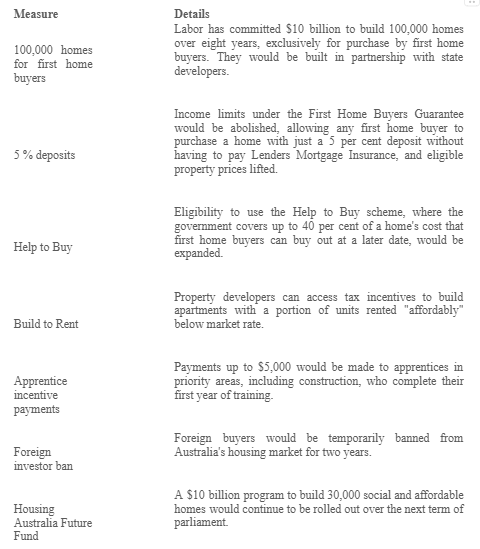
Deposit scheme expansion: a double-edged sword
Labor’s signature policy – extending the 5 per cent deposit scheme to all first home buyers regardless of income – represents a fundamental shift in housing accessibility.
Under the expanded program, approximately 80,000 Australians are expected to enter the property market annually, up from the current 50,000 who access the income-capped version.
By removing the substantial barrier of lenders’ mortgage insurance and the need for a 20 per cent deposit, the policy dramatically lowers the entry threshold to homeownership. For the typical Sydney property, this could mean the difference between needing a $200,000 deposit and requiring just $50,000 – potentially saving years of saving time for aspiring homeowners.
However, economic fundamentals suggest this policy is likely to drive price growth in the short term. The Productivity Commission’s research on first home buyer incentives consistently shows that measures increasing purchasing power, without commensurate supply increases, typically lead to price escalation in targeted market segments.
With more buyers able to enter the market simultaneously and competing for the existing housing stock, upward price pressure becomes inevitable.
Supply challenges amid construction headwinds
Labor’s ambitious target of building 1.2 million new homes over five years, including the 100,000 dedicated first-buyer properties, represents an unprecedented construction challenge.
Australia has never achieved this volume in any five-year period, with the closest being approximately 1.1 million homes last decade … a figure achieved with significant foreign capital investment.
The current construction environment presents substantial obstacles to meeting these targets:
Building costs continue to outpace house price growth, making new construction increasingly uneconomical. For example:
- Industry insolvencies exceed 1,200 annually and continue to rise.
- Labor productivity remains low compared to historical standards.
- Construction timeframes have extended from 6.5 months pre-pandemic to over 10 months today.
These factors severely constrain the industry’s capacity to deliver on Labor’s housing targets. The expanding gap between housing demand and supply, now approaching 500,000 dwellings nationwide, will likely continue to widen before significant new stock becomes available.
Market momentum building before policy implementation
Labor’s victory comes at a time when Australia’s housing market is already showing renewed momentum. April data confirmed accelerating price growth across both houses and units nationwide, with house prices nationally rising by 0.4 per cent to reach a median of $917,433, representing annual growth of 5.2 per cent.
This momentum, evident across 13 of 14 regions when comparing recent three-month periods, demonstrates the market’s underlying strength even before the implementation of the new housing policies. The widespread acceleration suggests we’re entering a new phase in the market cycle, with stronger conditions likely ahead as interest rate cuts materialise.
Markets now anticipate an almost certain cut at the next RBA meeting on May 20, which would benefit mortgage holders significantly and will almost certainly direct more money into the housing market. More cuts are expected to come through the remainder of the year, providing further stimulus to an already strengthening market.
Global uncertainty enhancing property’s appeal
The Labor government takes office amid significant global economic uncertainty. Trump’s “Liberation Day” tariffs have created substantial turbulence across financial markets worldwide, reflected in the unprecedented spike in the VIX Index – Wall Street’s ‘fear gauge’.
In this environment of market volatility, residential property offers several distinct advantages that will likely attract increased investment:
- Greater price stability compared to share markets.
- Tangible asset security with intrinsic utility value.
- Immediate benefits from anticipated interest rate cuts.
- Supply constraints supporting existing property values.
These factors, combined with Labor’s buyer-friendly policies, create a perfect storm for accelerated price growth across Australia’s property markets.
The paradox: short-term pain for long-term gain
The paradox of Labor’s housing policy is that while it risks exacerbating affordability challenges in the short term through price inflation, it may ultimately create the conditions for improved affordability in the longer term.
Higher property prices, while challenging for new entrants, makes it possible for developers to overcome construction barriers and bring new supply to market. As values rise, previously marginal development projects become viable, and the industry gains additional capital to expand capacity.
Labor’s complementary policies – including apprentice incentives, Build to Rent tax benefits, and the Housing Australia Future Fund – aim to address supply-side constraints gradually. However, these measures will take time to yield significant results, likely trailing behind the immediate demand stimulus of the deposit guarantee scheme.
Outlook: Prices rising to meet construction costs
The fundamental economic equation that will drive housing supply recovery is straightforward: house prices need to rise sufficiently to match or exceed construction costs.
One of the key challenges plaguing Australia’s housing supply has been that building costs have outpaced house price growth, making it more affordable in most parts of Australia to buy an existing home than build a new one.
As house prices accelerate under Labor’s policies, they will inevitably reach levels that make new construction economically viable again. This price-to-cost equilibrium is the essential mechanism that will stimulate developers to increase supply despite the significant headwinds facing the construction industry.
The combination of Labor’s demand-focused policies, already-building market momentum, anticipated interest rate cuts, and global economic uncertainty points to one clear outcome: accelerating property price growth through 2025 and potentially beyond. While this presents affordability challenges in the immediate term, it creates the necessary economic conditions for substantial new housing development.