





















Buyers are starting to see a drop in housing values, but we still need increased supply to make property affordable – and it’s not happening anytime soon.
It does make me laugh. When the residential property market is booming, all the media coverage is focused on the lack of affordability for first home buyers. My friends talk about how hard it is for their adult children to buy into the market and how the Bank of Mum and Dad is being tapped to help out.
But when property values fall, the media focus is firmly on the drop in value for your biggest asset and that it is turning to a buyer’s market. No mention that this is good news for first home buyers as housing affordability improves. My friends stop talking about their kids getting into the market and worry about the value of their property falling.
A slowing market?
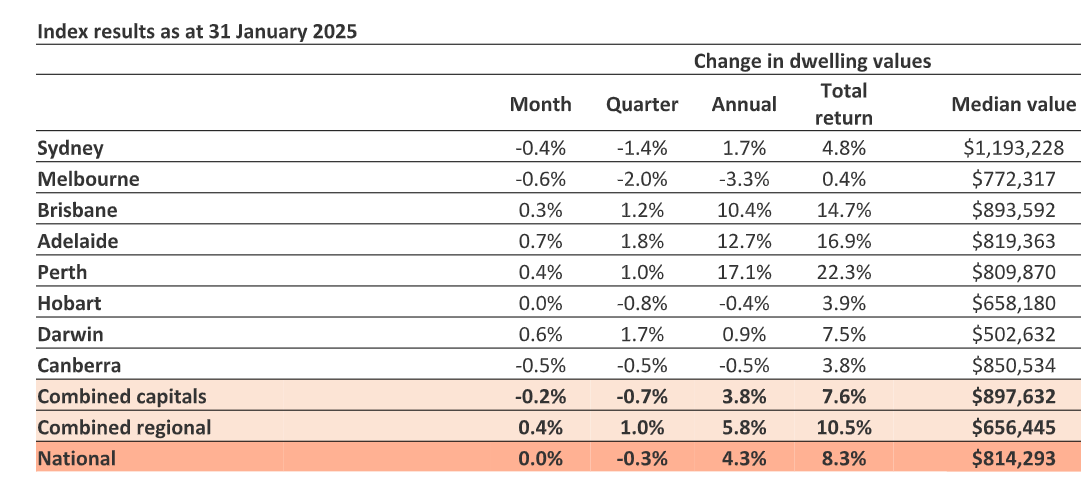
According to the latest figures from property research group, CoreLogic, three of the eight capital cities recorded a decline in home values in January. Melbourne recorded the sharpest drop (-0.6 per cent), followed by the ACT (-0.5 per cent) and Sydney (-0.4 per cent). Hobart home values stayed steady in January.
Brisbane and Perth continued to record growth in home values, but there has been a clear and steady loss of momentum in these markets – especially in the detached housing sector where value growth has noticeably eased.
Perth is now recording a slower rate of growth than Brisbane and Adelaide over the rolling quarter. In the June quarter of 2024, growth in Perth home values was 7.1 per cent, easing back to just 1 per cent growth in the three months to January.
Adelaide has shown a more resilient trend, although the pace of gains is slowing. Adelaide’s value growth has led the state capitals over the past six months with a 4.8 per cent gain. Annual growth in national home values has more than halved since moving through a cyclical peak over the 12 months ending February 2024 (9.7 per cent), slowing to 4.3 per cent in January.
CoreLogic’s national Home Value Index (HVI) is now down 0.3 per cent from the record highs recorded in October last year.
But potentially lower mortgage rates, a subsequent lift in borrowing capacity, as well as an under-supply of newly-built housing could be setting the foundations for a relatively shallow housing downturn, according to CoreLogic’s research guru, Tim Lawless.
Supply is still the issue
Property is all about demand and supply, but Australia’s supply is terrible.
This is what CoreLogic is talking about when it points out that a shortage of new houses being built will put a floor under property values. There is unlikely to be any sort of property crash in the foreseeable future.
Despite a small uptick in building approvals over the month of December, Australia fell short by 68,606 homes of its annual 240,000 housing target in 2024.
According to the Australian Bureau of Statistics, there was a very slight increase (+0.7 per cent) in the volume of new home building approvals during December 2024.
This was the result of a 6 per cent increase in higher-density apartment dwelling approvals during the month. But detached house building approvals dropped by 2.8 per cent during December.
When looking at the yearly performance, 171,394 new homes received approval during 2024 overall, a modest gain (3.9 per cent) on the year before. This was driven by a 7 per cent gain in detached house approvals during 2024.
Currently, all states and territories have fallen short of their Housing Accord target. If building continues at this pace, the housing shortage will continue for some time.
Making housing affordable
So yes, we are seeing a drop in property values, but until our housing supply issues are properly addressed and resolved, residential property will remain a tough market to enter. There is simply not enough stock to meet demand.
Until then, let’s focus on increasing Australia’s housing supply to make the market more accessible, not just on dropping property values.