



















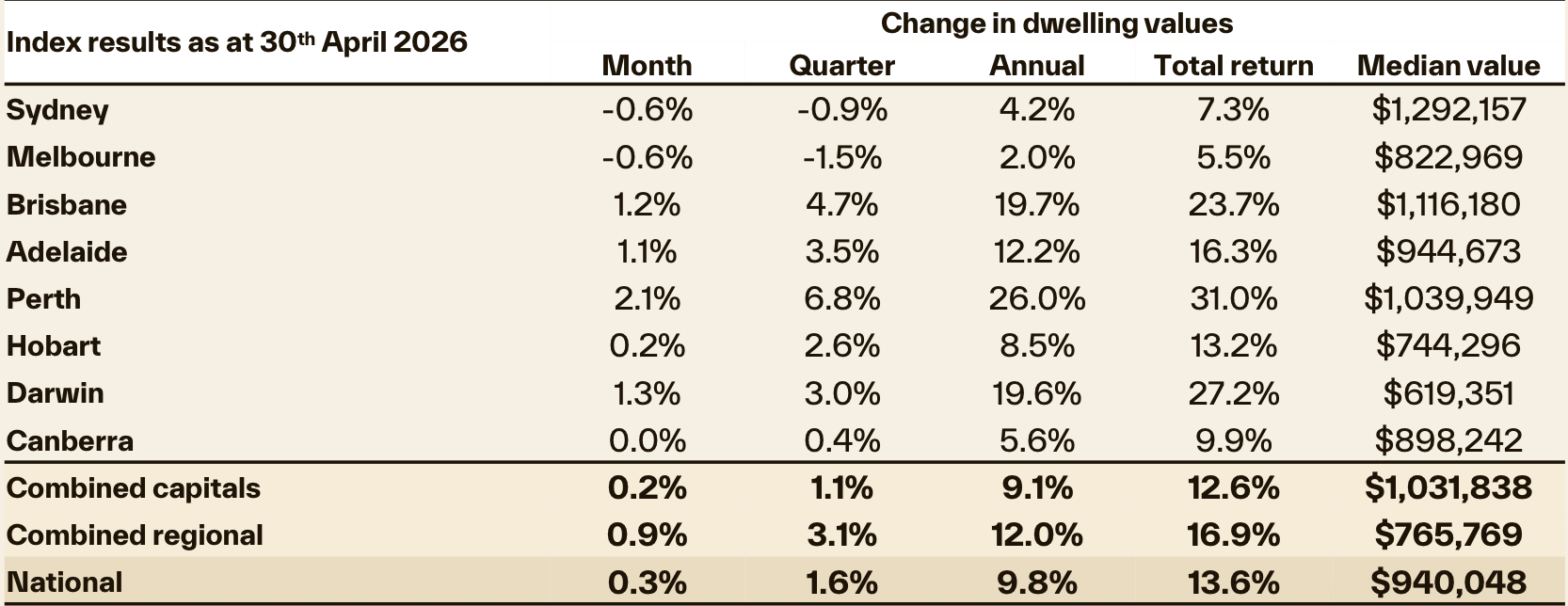
Cotality’s national home value index rose just 0.3 per cent in April – the slowest pace of growth since January 2025.
The national result was dragged lower by Sydney and Melbourne, where values fell 0.6 per cent over the month.
Sydney home values are now 1 per cent below their November peak, while Melbourne values are 1.9 per cent below their November cyclical high and 2.3 per cent below the March 2022 peak.
Every capital city recorded a slower pace of growth in April, but conditions remain highly diverse.
Softening markets
Perth’s growth is clearly losing steam, but the market remains strong; values rose 2.1 per cent in April, while Brisbane, Adelaide and Darwin also saw growth slow, but from a high base, with values still rising by more than 1 per cent month-on-month in each city.
Higher interest rates, plunging consumer confidence, rising inflation and steeper mortgage repayments are all combining to have a major impact.
Softer housing conditions have been accompanied by a slowdown in buyer demand.
Estimates of capital city home sales over the past three months were 5.4 per cent lower than a year ago and 7.4 per cent below the previous five-year average. Advertised listings of properties have also lifted in the weakest markets, sitting 9.4 per cent above the five-year average in Sydney and 2.2 per cent above average in Melbourne.
While inventory remains tight across the mid-sized capitals, advertised listings are also rising in these markets … albeit from a low base and still well below typical levels for this time of year.
This imbalance between demand and supply is also showing up in auction clearance rates, which have held below 55 per cent since the last week of March.
Where prices are rising
Growth is increasingly concentrated in lower-priced segments. Every capital city is recording stronger growth in the lower value quartile, as demand concentrates where credit availability and first home buyer incentives have the greatest influence.
In Sydney, lower-tier house values are up 2.9 per cent year-to-date compared with a 3.3 per cent fall across the most expensive quarter of the market.
Regional markets have been more resilient amid the broader slowdown, supported by relatively lower values and above-average internal migration.
In some good news …
While property values are softening, the pipeline of new homes being built to meet demand is increasing, according to the Housing Industry Association (HIA).
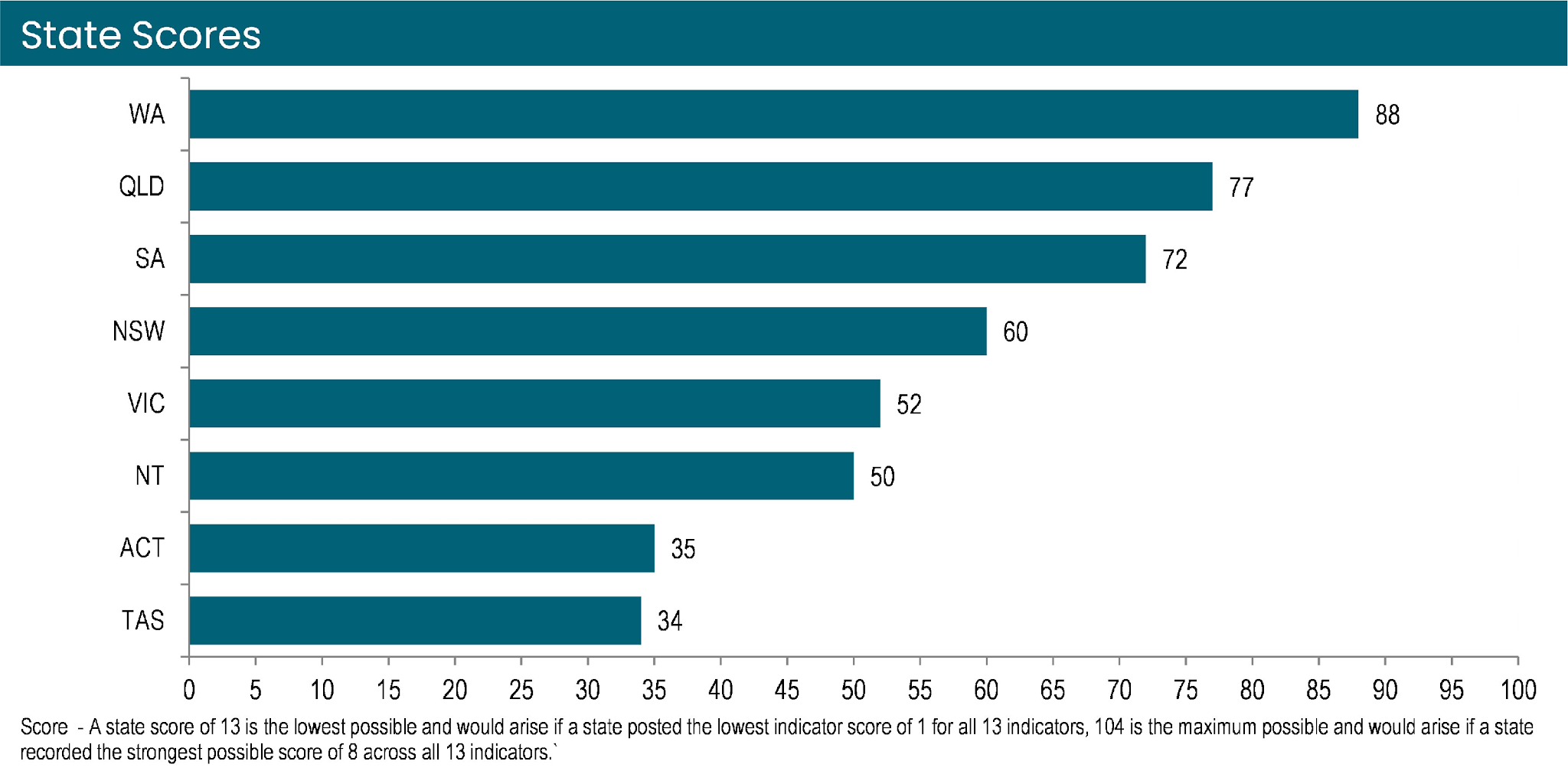
Their Housing Scorecard benchmarks construction activity across each state and territory against long-term averages, using indicators such as home building and renovation activity, lending data and population flows.
Western Australia’s home building recovery has produced the strongest detached housing sector in the nation, the equal-strongest renovations sector, and the equal second-strongest multi-unit market.
Queensland and South Australia also appeared in the top three spots, comfortably ahead of the other states. New South Wales, Victoria and the Northern Territory sat in the middle of the pack and are still seeing relatively weak volumes of new home building entering the pipeline.