




















Following on from comments about the ill-judged broadening of the federal government’s 5 per cent home deposit scheme, there is now clear evidence of how it is fuelling the property boom.
According to Ray White chief economist, Nerida Conisbee, Australia’s most affordable housing is experiencing significantly stronger price growth than typical properties, with the bottom quartile of the market outperforming across most capital cities as government incentives and affordability constraints drive intense competition for entry-level homes.
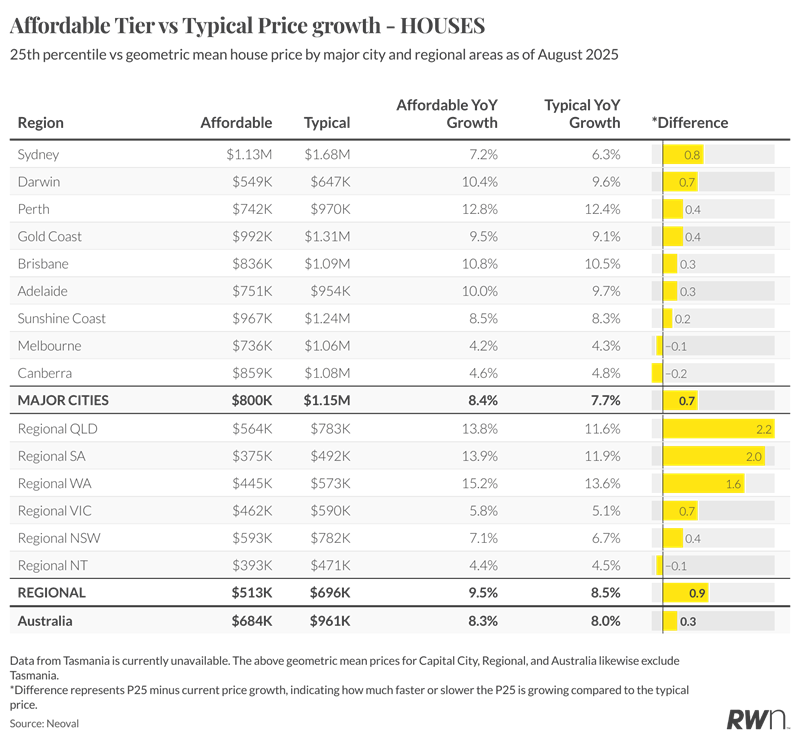
Nationally, affordable houses (at the 25th percentile price point) are growing at 8.3 per cent annually, slightly ahead of the 8 per cent growth for typical properties. Meanwhile, affordable units are surging at 7.1 per cent – versus 6.3 per cent for the broader unit market.
However, the story varies dramatically across cities, with some markets showing substantial affordable premiums whilst others display no discernible difference.
Entry market in demand
Sydney leads the affordable house outperformance with cheap properties at $1.13 million and growing 7.2 per cent annually. That’s nearly a full percentage point ahead of typical Sydney houses at 6.3 per cent.
This reflects the intense competition among cashed-up buyers seeking the most affordable entry point into Australia’s most expensive housing market.
Regional markets are showing even stronger affordability premiums, with affordable houses in regional Queensland surging 13.8 per cent annually, compared to 11.6 per cent for typical homes. Similar trends are evident in regional South Australia and Western Australia, where affordable houses are growing 2.0 and 1.6 percentage points faster, respectively, than their typical counterparts.
The outperformance of affordable housing coincides with an unprecedented expansion of first home buyer support schemes.
Government incentives fan the fire
The federal government’s decision to bring forward and significantly expand the First Home Buyer Guarantee scheme to October 2025 – three months ahead of schedule – has removed key barriers for entry-level buyers.
The expanded scheme eliminates income caps entirely and dramatically raises property price thresholds to $1.5 million in Sydney (from $900,000), $950,000 in Melbourne (from $800,000), and $1 million in Brisbane (from $700,000).
This allows first home buyers to purchase with just a 5 per cent deposit without paying lenders mortgage insurance, potentially saving tens of thousands of dollars in upfront costs. Treasury estimates suggest the uncapped scheme will issue an additional 20,000 guarantees in its first year, directly targeting the affordable segment where competition is most intense.
The department’s modelling indicates this will add approximately 0.5 per cent to house prices over six years, though the immediate impact appears concentrated in the entry-level market. Beyond federal schemes, first home buyers benefit from various state-based incentives including stamp duty exemptions, grants, and shared equity programs.
These layered incentives create powerful demand drivers specifically targeting properties in the affordable tier.
The trend is nation-wide
Notably, Melbourne and Canberra stand out as exceptions to the affordable outperformance story.
Melbourne’s affordable houses are growing at 4.2 per cent annually, actually lagging behind typical Melbourne properties at 4.3 per cent – the only major city where this is occurring.
Similarly, Canberra’s affordable houses trail typical properties by 0.2 percentage points. For units, both cities show identical growth rates between affordable and typical properties, with no discernible premium for cheaper stock.
The limited stock of affordable housing in most markets is intensifying competition among entry-level buyers.
With median house prices now approaching $1 million nationally, the pool of sub-$800,000 properties has shrunk dramatically, concentrating demand among remaining affordable options.
Affordable units are outperforming even more strongly in the unit markets, with Perth leading the way – recording 16.5 per cent annual growth for affordable units compared to 14.5 per cent for typical apartments.
This trend appears likely to persist while government support remains targeted at first home buyers and affordable housing supply constraints continue.
Beyond the market
The data suggests that while overall market conditions drive broad price movements, policy interventions and supply dynamics are creating increasingly divergent performance across price tiers. This has significant implications for housing affordability and market structure going forward.
A report from property research group Cotality found that under the old price caps for the 5 per cent deposit scheme, around a third of the 4,848 house and unit markets analysed nationally had a median value below the respective limits.
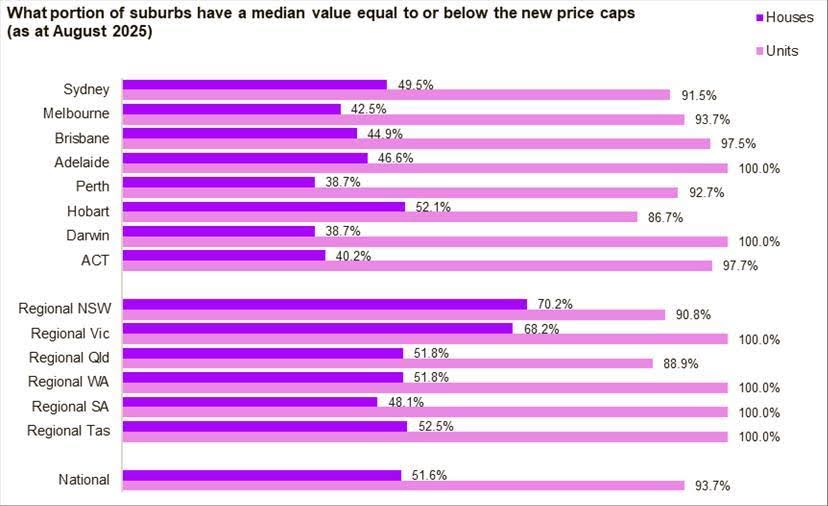
Under the expanded limits, this portion jumps to 63.1 per cent, including 51.6 per cent of house markets and 93.7 per cent of unit markets.
Adelaide saw the largest increase for houses, with 46.6 per cent of suburbs (130) now qualifying, up from just 2.9 per cent (8) previously. Brisbane saw the largest proportional increase for units, with 97.5 per cent of suburbs (153) now qualifying, up from just 36.9 per cent (58).
Property values in both these cities are already strong … now they’re set to get stronger.