




















We all know Australia has a housing crisis. Just chat to a first home buyer in shock at property values, or anyone struggling to find (and afford), a home to rent. While there are lots of issues contributing the problem, a couple stand out.
These are the nation’s two biggest ‘property pain points’:
Property pain point #1:
The 5 per cent deposit scheme is boosting demand and values
Up until now, everyone has been making informed judgements on just how much the federal government’s 5 per cent deposit scheme has been impacting the residential property market. But now, property research group Cotality has the early facts.
Cotality says the unusually strong home value increases in October coincided with the expansion of the 5 per cent deposit scheme. The policy enables eligible first home buyers to secure a low-deposit home loan without lender’s mortgage insurance. From October 1, it was scaled up to unlimited places and income eligibility, and the price caps associated with the scheme were increased across most regions.
So how did it impact property values in its first month of operation? National home values rose 1.1 per cent in October, the fastest monthly pace of growth since May 2023. But monthly gains had already been accelerating since the first interest rate cut in February, and values were also buoyed by the traditional ‘spring selling season’ and low levels of stock.
According to Cotality data, properties with an estimated value below the new caps of the scheme did outperform in October, but this has been the case for some time, as serviceability and affordability constraints have increasingly encouraged higher-income buyers to lower-value market segments. The level of outperformance was also within historic ranges for most markets.
In some markets, there has been a more notable increase in values below the scheme’s thresholds, suggesting a localised market impact. These were in desirable markets of Sydney (Northern Beaches, North Sydney and Hornsby, Eastern Suburbs) and Melbourne (Inner East), and the popular regional centres of Wide Bay, the Central Coast and Geelong.
Nationally in October, dwellings with value estimates falling within the price caps of the 5 per cent deposit scheme increased 1.2 per cent, compared with 1 per cent for dwellings above the caps. To put that into perspective, lower-value properties have outperformed the higher end of the market for the better part of two years.
Between the house and unit markets, houses with estimated values below the price caps recorded a larger outperformance than units. National house values below the caps rose 1.3 per cent in the month, compared with 1 per cent for houses above the caps. Units with estimated values below the caps saw value growth closer to the average for those above the caps.
Property pain point #2:
Solving the supply shortage
I’ve always said property markets are driven by demand and supply. It’s that simple. Apart from higher demand, supply of properties to meet demand is getting to a stage of chronic shortage. And it’s getting worse by the day. Ray White’s Chief Economist, Nerida Conisbee, has produced the below research which shows just how chronic the shortage is becoming.
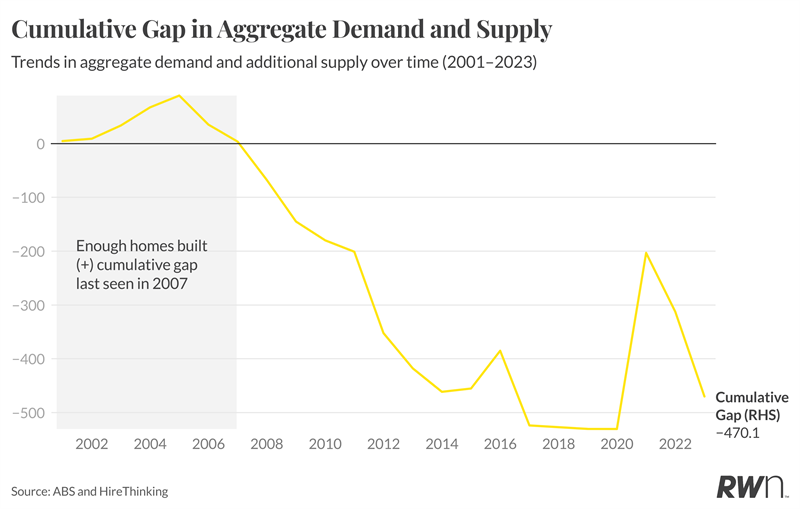
While Nerida acknowledges that the federal government’s goal to deliver 1.2 million homes over five years is the right one – and would finally allow us to catch up on the homes we haven’t built since 2007 – she believes the challenge lies not in the target itself but in the capacity to achieve it.
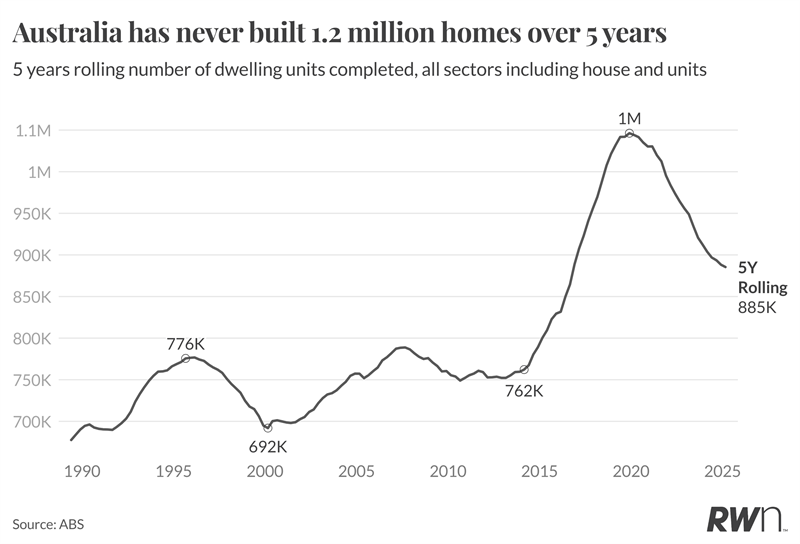
We have been under-building for almost two decades. Even if demand moderated, we would still need to deliver around 225,000 to 240,000 homes each year to restore balance in the property market. Completions currently sit closer to 190,000, and the deficit grows every year we miss that mark.
The major blockage to boosting housing supply is that the workforce required to reach that level of output simply doesn’t exist. The Housing Industry Association estimates that meeting the national target would require an increase of about 30 per cent in skilled trades.
That’s before accounting for retirements or workers leaving the industry. Even with record migration, faster training and higher participation, that kind of growth is implausible.
Nerida believes the solution could lie in changing the traditional way we build houses. Modern Methods of Construction – known globally as MMC, or modular building – shift much of the process off-site. Walls, floors and entire rooms are manufactured in factories, transported to site, and assembled in days. It’s faster, cleaner, and requires fewer workers on site, effectively substituting labour with precision manufacturing.
Australia currently has low uptake, with only around five per cent of new homes using some form of modular construction. In Sweden, it is particularly high at around 84 per cent, while Japan sits at 13 per cent, the United Kingdom at 16 per cent, and the United States at about three per cent.
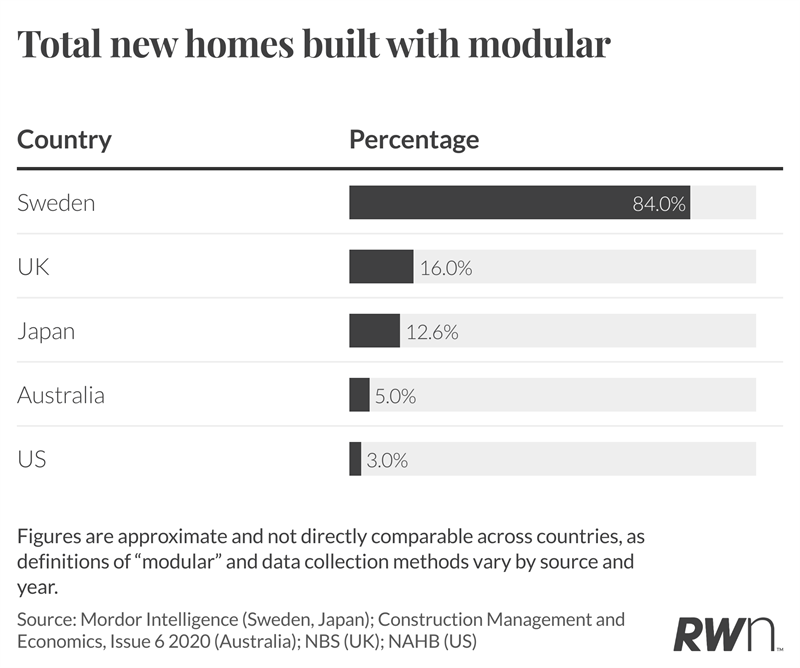
The irony, according to Nerida, is that our conditions (like high wages, labour shortages and strong housing demand) are exactly those that make modular construction work elsewhere. In fact, consulting company McKinsey & Company identified Australia’s east coast as one of the most suitable markets in the world for modular construction, alongside California, London and major German cities.
Gets you thinking, doesn’t it, that this may be a good solution for our housing crisis?