




















Housing policy continues to be a big political issue as politicians scramble to try and tackle affordability. Let’s take a look at how Australia’s ‘property bubble’ compares to the rest of the world:
Australians love property and investing in “bricks and mortar”. The problem is, with the sharpest, shortest rise in interest rates, servicing home loans has been an enormous drain on household finances.
As I’ve written for months, there is no silver bullet to solving the housing crisis. It’s a combination of making it easier to build new homes, increasing land supply and reducing construction costs.
Global housing bubble trends
Recently I came across two terrific graphs which put our residential property issues in some global perspective. You know how much I love a good graph to distil a complex financial issue. I subscribe to a design newsletter called Voronoi which shared these two charts.
The first one ranks the global housing ‘bubble’ markets and how they performed in the last financial year. Dubai and Warsaw had accelerated housing growth performance, while Hong Kong and Paris saw their property markets deflate badly.
Florida’s Miami, with it’s booming demand in luxury living, was flagged as having the greatest housing bubble risk worldwide.
Australia’s biggest bubble property market has always been Sydney, which showed only a very small rise in value as the big capital city markets slow.

Aussie first home buyers not alone
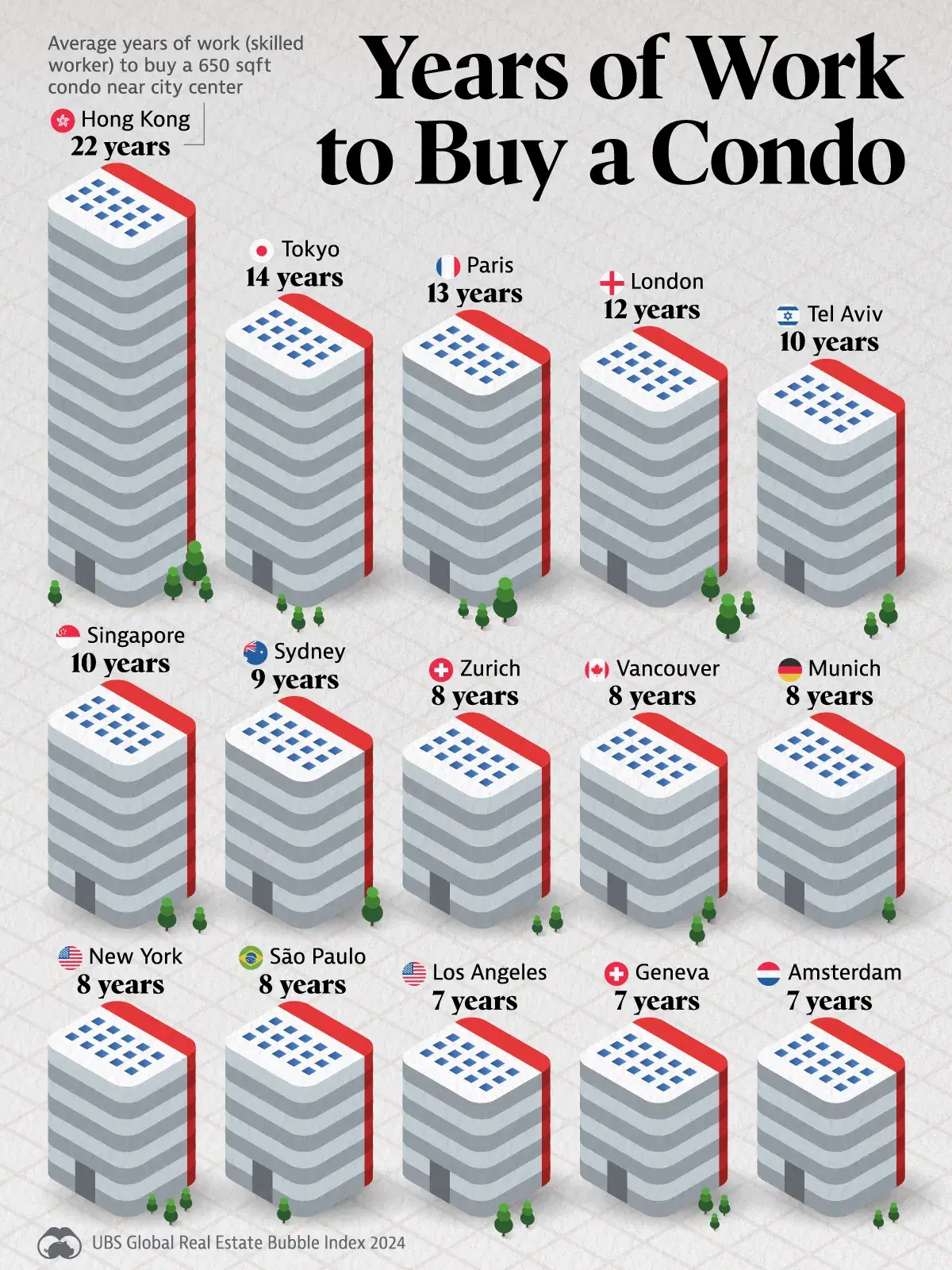
The other interesting chart from Voronoi concerns first home buyer affordability and the years of work it takes to buy an apartment. Sydney sits in the top 10 in terms of years to pay for an apartment but we’re not alone as there are a surprising number of other cities where affordability is a big issue.
For instance, those living in Hong Kong wanting to purchase a 650 sqft apartment as a first home, are looking at 22 years of work. For Londoners, this figure is 12 years. It is eight for those living in the Canadian city of Vancouver and 14 for future Japanese home owners in Tokyo.
The difficulty of getting into the property market is a discussion that is happening in other parts of the world too. It would seem Australia’s property ‘bubble’ is floating alongside other nation’s. And some are even much bigger than ours.