





















A record number of property investors are selling because of rising costs, legislative uncertainty, and concerns over proposed federal tax reforms.
Basically landlords, much maligned by tenants and governments for ‘causing the current rental crisis’, are pulling out and investing their money somewhere else.
As I’ve warned previously, higher taxes and reducing the rights of landlords run the risk of property investors selling, cutting the number of properties available for rent and adding to the crisis.
Selling up
The 2025 Annual Property Investor Sentiment Survey by the Property Investment Professionals of Australia (PIPA) reveals that 16.7 per cent of investors sold at least one property in the past year, up from 14.1 per cent in 2024 and 12.1 per cent in 2023.
It’s the highest rate of investor sales since PIPA began asking investors whether they had sold any properties in the past year. The results highlight a clear and escalating trend that threatens the nation’s rental housing supply.
When PIPA first asked this question in 2022, about 17 per cent of investors said they had sold at least one investment property in the previous two years – equivalent to just 8.5 per cent annually. That’s half the current rate of investor sales.
Queensland continues to lead the nation in investor exits, with 35.5 per cent of respondents selling at least one property in the state, up from 33.4 per cent last year. Victoria followed closely at 30 per cent, while New South Wales saw a sharp decline to 11.8 per cent, down from 25.4 per cent in 2024.
When asked whether they would continue investing in property if negative gearing was altered, 53 per cent said they would stop investing. An additional 25 per cent were unsure, leaving just 22 per cent willing to continue under a revised negative gearing policy.
Similarly, if the Capital Gains Tax (CGT) discount were reduced to 25 per cent after 12 months of ownership, 35 per cent of investors said they would exit the market. Another 29 per cent remained undecided and 36 per cent said they would continue investing under the revised CGT conditions.
Landlords are such an easy scapegoat for the rental crisis. But wouldn’t it be better to encourage property investment to increase the amount available stock for rent, rather than driving them out of the market with higher taxes, reduced rights and casting them as villains?
Rental market stays tight
Now, to look at the state of the current rental market …
A balanced rental market typically has a vacancy rate around 3 per cent, indicating enough supply to meet demand. However, according to SQM Research’s latest data, the national residential vacancy rate held steady at just 1.2 per cent in August – less than half the level needed for a balanced market.
So the rental crisis continues and shows no signs of improving.
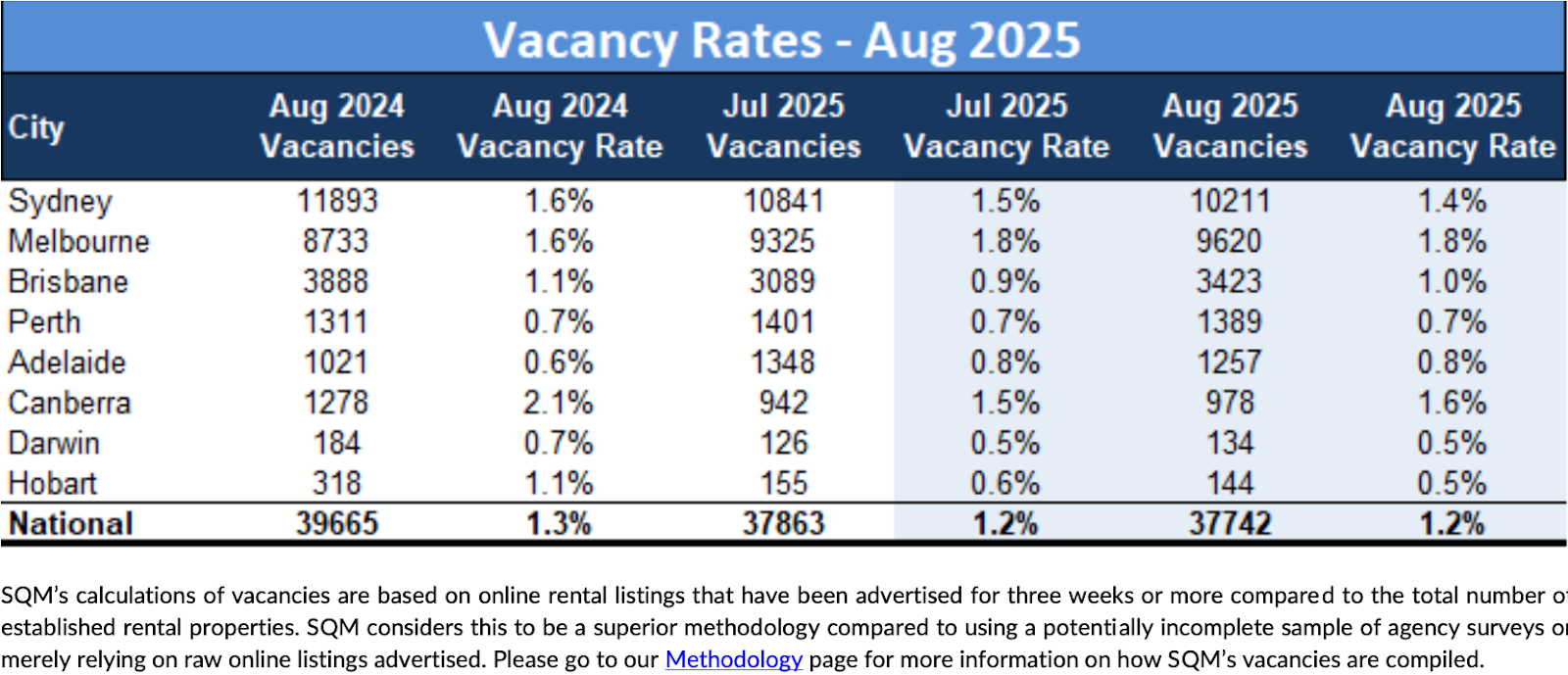
Across the capital cities, SQM found:
Sydney: Tenant demand continues to tighten the market, pushing the vacancy rate down to 1.4 per cent (from 1.5 per cent). It’s the lowest in over a year.
Melbourne: Tight to stable vacancy levels persist as leasing activity slows, with the rate holding at 1.8 per cent.
Brisbane: A modest rise in vacancies to 1 per cent, though the city remains one of the tighter rental markets nationally.
Perth: Tightness continues, with the vacancy rate unchanged at 0.7 per cent.
Adelaide: Very low vacancy conditions with the rate steady at 0.8 per cent.
Canberra: A slight seasonal lift saw the vacancy rate rise to 1.6 per cent.
Darwin: The market remains super tight, with the vacancy rate holding at just 0.5 per cent.
Hobart: Strong rental demand pushed the vacancy rate down to 0.5 per cent (from 0.6 per cent).