





















We all know that talking about property is close to a national sport (behind AFL of course) here in Australia.
With the Reserve Bank Governor, Michele Bullock, adding to the chat this week, it’s been as captivating a conversation as watching a grand final. Well not quite, but here’s what went down.
A supply issue
When Bullock fronted the Parliament Economics Committee this week, she was questioned on a range of issues, including what drives property values.
Notably, she was firm in stating that interest rates are not the primary driver of house price growth.
Asked by Allegra Spender, the MP for Wentworth, if housing supply was keeping up with demand, Bullock answered:
“Yes, you’re absolutely right, it’s a supply issue and are we close to meeting it? All estimates suggest we are not.”
She also pointed to new housing, which caters for larger families, being a mismatch for our nation’s needs.
“Supply is an issue but demand is impacted not just by the number of new households being formed but the average household size,” she said, pointing out that Australian households have been decreasing, not increasing in size.
Bullock and RBA assistant governor, Brad Jones, were also asked if they felt new government policies, such as the 5 per cent deposit scheme, will fuel higher prices for houses.
“At the very margin, you may see a little more upward pressure on house prices in the short term, recognising that first-home buyers account for about 20 per cent of the flow of new housing credit,” Mr Jones said.
The housing supply topic is indeed an ongoing national conversation that gets brought up among us almost as often as the footy. But I reckon it needs to.
Just look at the market right now.
A seller’s market
We are seeing a big jump in homes being put on the market (it’s peak selling season) – and they are being snapped up faster than Grand Final tickets.
Capital city homes that were auctioned last week were at the highest weekly volume since the first week of June and a solid 11.4 per cent rise from the week prior. According to property research group Cotality, the preliminary auction clearance rate rose by 3.1 per cent to 77.9 per cent – the capital’s highest early clearance rate since late October 2021 (78.9 per cent).
Melbourne recorded a preliminary clearance rate of 78.6 per cent, its highest since the week ending October 24, 2021. In Sydney, there was an 11 per cent increase in homes taken to auction, with a 77.9 per cent clearance rate – the fourth-highest early success rate so far this year
The AFL Grand Final of property values: Geelong vs Brisbane
So if talking about property is a national sport, then every Australian will love this.
Property giant, Ray White, released a fun comparison between the Geelong and Brisbane property markets in the lead up to yesterday’s AFL Grand Final.
Both Geelong and Brisbane represent two of the strongest connections between sporting success and real estate performance.
Both teams (Lions and Cats) deserved to be in the grand final, but their property stories are very different …
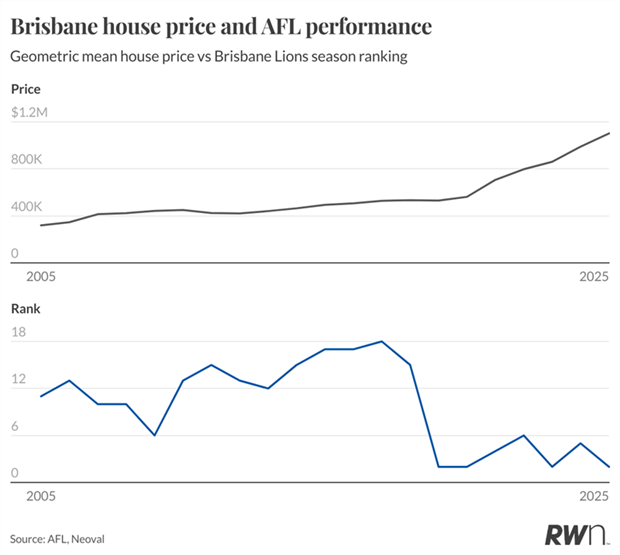
The Lions’ transformation under Chris Fagan mirrors one of the most dramatic property turnarounds in recent memory. Between 2005 and 2018, Brisbane averaged 13th on the AFL ladder, while the city’s housing market crawled along with just 18 per cent growth over 14 years.
The team was mediocre, the city’s confidence was flat, and property investors looked elsewhere.
Then everything changed
As the Lions roared back to relevance with preliminary finals, Brisbane house prices have exploded 107 per cent over the past six years.
When your team consistently delivers September thrills, your city becomes more attractive, more confident, more valuable.
On the other hand
The Cats have written the playbook on how sporting excellence drives property growth.
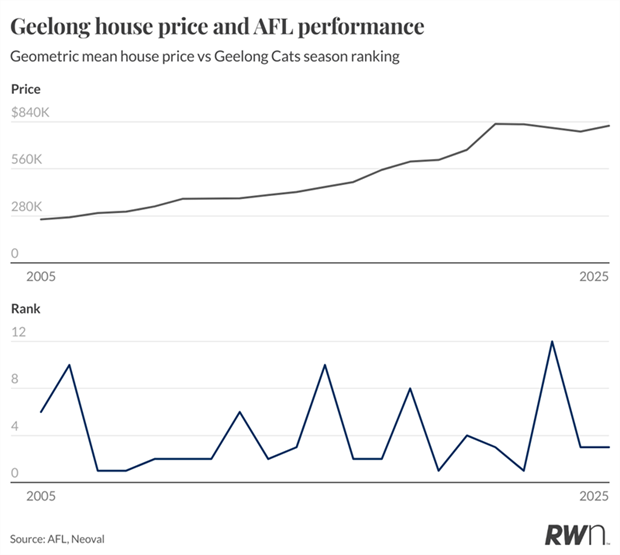
They have had sixteen top-four finishes in the last 20 years, including premierships in 2007, 2009, 2011 and 2022 – helping to transform Geelong from industrial town to a lifestyle destination.
Each September run also brings national media attention and each premiership delivers civic pride that attracts investment and tourism.
Football success has become inseparable from the city’s economic development story, with the team serving as the city’s best marketing asset for attracting the population and investment growth that’s powered property appreciation.
The connection runs so deep that when the Cats had their worst season in decades (12th in 2023), property prices dropped 3 per cent, one of only two declines in the past 20 years.
When Geelong struggles, the market notices.
Here’s where it gets interesting
Since 2018, Brisbane house prices have surged 106 per cent compared to Geelong’s 35 per cent. Even more telling: Brisbane’s membership has tripled from 24,867 to 75,115, while Geelong’s grew just 44 per cent to 92,379.
This season alone, Brisbane added 18 per cent more members while Geelong had just 1.7 per cent growth.
Geelong may be a strong team, but they’re stagnating where it matters most: community engagement and market confidence.
Brisbane brings explosive momentum from a city rediscovering its sporting soul, while Geelong represents a mature market that’s already captured most of its upside.
Ah, combine footy and property, and you have some great Aussie water cooler chat.