




















They are the dream homes we’ve long drooled over in glossy real estate pages. Here’s what’s happening in luxury property at a time when attention is focused on the other end of the market—affordable first homes.
Since the broadening of the federal government’s 5% Home Deposit Scheme, there has been a huge amount of analysis on how it has pushed up the values of property at the lower end of the property market.
As a result, there seems to have been very little coverage of how luxury property has been performing.
But Ray White economist, Atom Go Tian, has just released a detailed look at the high end property market around the country.
Have a look:
Perth: No signs of slowing
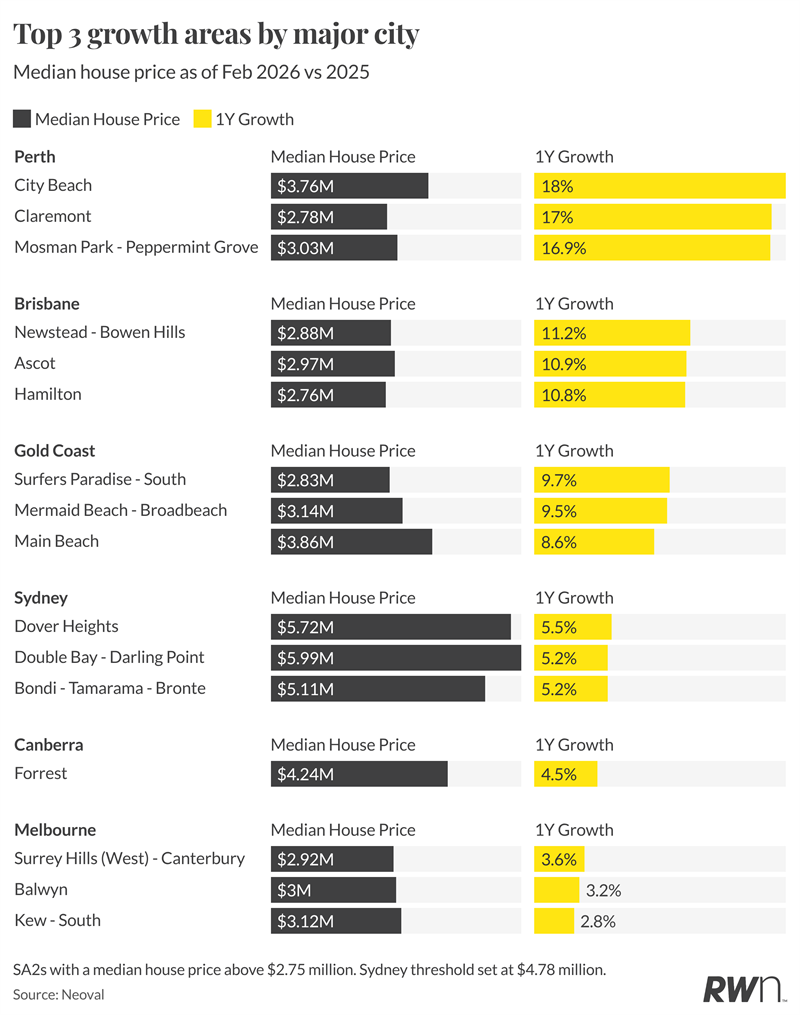
City Beach has always been one of Perth’s most coveted addresses with its ocean views and quiet streets. Now it has the momentum to compete on a national level: 18 per cent growth in 12 months, backed by a strong state economy, sustained population inflows, and a prestige market where stock has simply not kept pace with demand.
This is not an isolated spike either. Claremont is up 17 per cent to $2.78 million, while Mosman Park–Peppermint Grove grew 16.9 per cent to $3.03 million.
Perth is in its third consecutive year of double-digit growth in the luxury space, a run long enough that it no longer needs explaining as a post-pandemic effect or a commodity boom byproduct. It’s simply where Perth luxury is now.
The gap between Perth and Sydney luxury prices, which was once vast, is narrowing.
Queensland: Following the same path, one year behind
Newstead–Bowen Hills is one of Brisbane’s most transformed precincts, a former industrial corridor that has become a riverside address for buyers who want proximity to the CBD without surrendering neighbourhood character. It grew 11.2 per cent over the past year to a $2.88 million median.
Ascot, where wide streets and heritage homes sit alongside Brisbane’s racing establishment, reached $2.97 million on 10.9 per cent growth.
Hamilton, perched on the river with long views and large blocks, posted 10.8 per cent to $2.76 million.
On the Gold Coast, the growth is spread across suburbs with distinct identities: Surfers Paradise South, Mermaid Beach-Broadbeach and Main Beach – coastal, resort-adjacent, and quietly residential in turn – all recorded growth between 8.6 and 9.7 per cent. Main Beach now sits at $3.86 million.
Sydney: Steady at the top
Sydney’s luxury market is growing, but at a measured pace. Dover Heights, Double Bay–Darling Point and Bondi–Tamarama–Bronte all recorded growth of between 5.2 and 5.5 per cent.
Sydney’s luxury market is not weakening. It’s consolidating at a price level that still commands a significant premium over every other major city, and last year’s prediction that prestige buyers might rediscover Sydney’s relative value appears to be playing out, if gradually.
Melbourne: A recovery, but a modest one
Melbourne’s luxury market has moved out of the mild contraction recorded last year. Surrey Hills (West)–Canterbury grew 3.6 per cent to a $2.92 million median, Balwyn increased by 3.2 per cent to $3 million, and Kew South went up 2.8 per cent to $3.12 million.
The pace, however, remains the slowest of any major market. Melbourne’s top luxury suburb grew at less than one-fifth the rate of Perth’s. For vendors who have watched other markets run hard, patience is still the requirement.
Canberra: a single data point, a clear signal
Only one Canberra suburb met the $2.75 million threshold used in this analysis: Forrest, with a median of $4.24 million and year-on-year growth of 4.5 per cent.
That scarcity reflects Canberra’s luxury market more accurately than any percentage figure – there’s simply very little supply at this price point, and what exists is moving steadily upward.