




















A study has revealed just how much the number of bedrooms in a property impacts the rate of rental growth. And it’s very interesting.
As the rental crisis continues, it seems tenants are shifting towards larger properties with more bedrooms, so the cost can be shared across more people.
CoreLogic has produced a fascinating study which shows growth in rents is slower for properties with fewer bedrooms than more. CoreLogic believes the reason could be the slight slowdown in overseas migration slowing demand for smaller, inner-city units.
CoreLogic’s new bedroom count metric (which analyses housing market performance segmented by the number of bedrooms) shows for houses, rents increased 8.4 per cent nationally in the year to June, and this ranged from a 7.6 per cent rise in houses with up to two bedrooms, to 8.7 per cent in larger houses with five bedrooms or more.
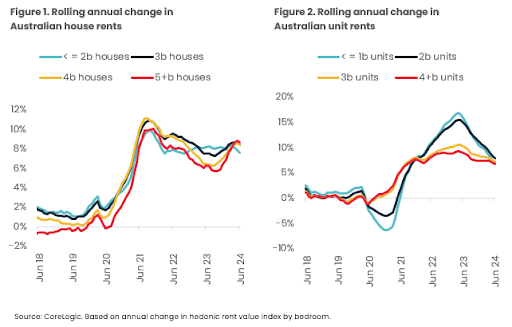
In home units and townhouses, there has been an even bigger slowdown in the rent growth of smaller dwellings. Annual growth in one-bedroom units and studios slowed from a peak of 16.8 per cent in the year to April 2023, to 7.1 per cent in the past 12 months. This was the weakest annual growth of unit rents by bedroom count in the period.
Similarly, two-bedroom units have seen a slowdown in annual rent growth from 15.4 per cent to 7.9 per cent in the past 12 months. Despite the slowdown, two-bedroom units maintained the highest rent growth on a national level.
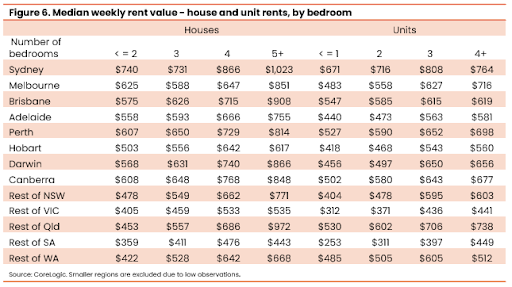
Interestingly, larger rental properties are showing more resilient rent growth, despite being more expensive. Large rental properties may actually be more feasible for renters in share situations, including households where different generations have moved back in together to share costs.
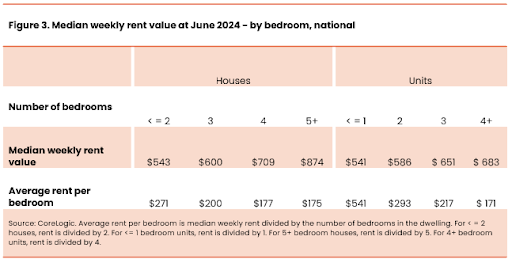
The higher the bedroom count in a property, the lower the average rent per bedroom (ie. total rent divided by number of bedrooms).
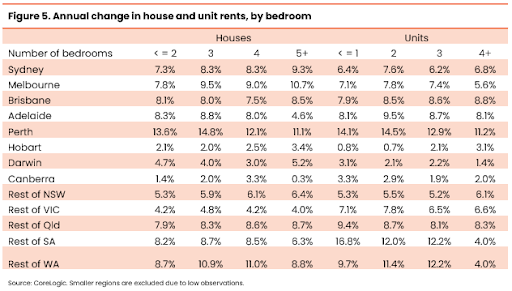
Despite larger houses seeing higher rent growth on a national scale, this is a trend largely led by NSW and Queensland, with Melbourne also showing higher growth in house rents with five or more bedrooms. In most capital cities, two-bedroom units have sustained the highest increases in rent over the year.
Cities where larger house rents are underperforming, such as Perth and Adelaide, are likely to eventually see a similar shift to higher demand for larger dwellings that can be occupied by shared households.