




















Be careful where you get money advice from …
I have always said that good advice is your best investment. There is plenty of advice out there, but the question is whether it’s “good”?
Today, you can’t believe everything you read on the internet (or scroll past on TikTok) but that’s where 29 per cent of adult Australians are learning about finance.
Gen Z are the most app-happy generation, with 22 per cent using the internet and 28 per cent using social media platforms like TikTok, YouTube, Facebook and Instagram to learn about money.
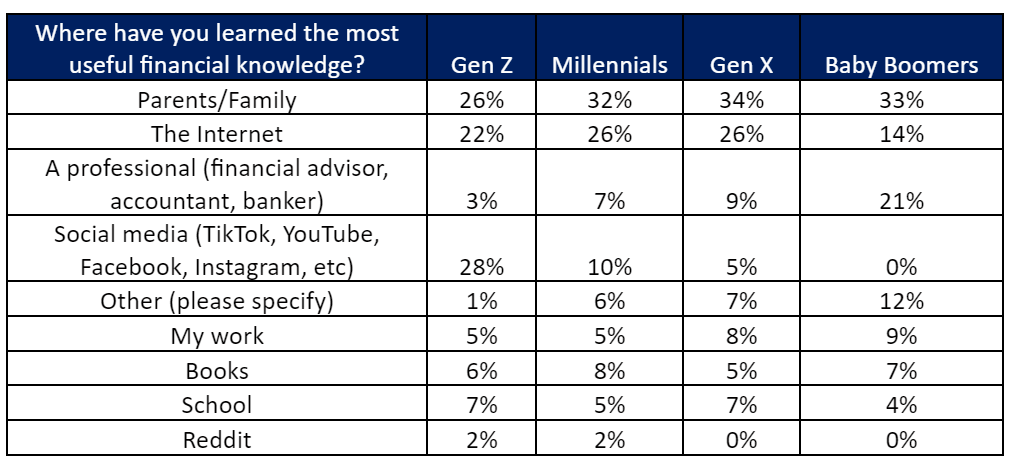
According to the survey by Compare the Market, the majority of Australians (32 per cent) learnt their most useful financial knowledge from their parents or family. Bear that in mind when you’re talking about money in front of your children.
Meanwhile, 11 per cent sought out a professional financial advisor, accountant or banker for their financial knowledge. This was followed by less than 10 per cent who got their most useful financial knowledge from work, books, school and Reddit.
In 2022, the Australian Securities and Investment Commission (ASIC) cracked down on social media influencers, warning they could face imprisonment and $1 million fines it they don’t obtain a financial services licence or quit promoting shares and investment funds online.
Since then, the corporate watchdog has issued several warnings about unlicenced financial advice. So, err on the side of caution.
Don’t take everything at face value and make sure you fact check any advice you see online. To avoid falling into a money trap, do a bit of desktop research to ensure what you’re seeing is credible.
For every helpful tip there could be hundreds of bad ones leading you down the garden path. I know that far too many Australians have missed out on a financial education at school and for them the internet is an easy way to access information.
Unfortunately, many of us don’t know how to distinguish between bogus and brilliant advice, especially on a topic we may be unfamiliar with – and there is plenty of unreliable information available that can easily lead you astray.
3 top tips to avoid bogus financial advice:
1. Don’t use a broad-brush approach.
There is no one-size-fits-all approach to managing finances, so be cautious about using tactics promoted online. What’s worked for one person might not work for you. It’s vital you take your own specific needs and circumstances into account.
2. Seek independent financial advice.
By going with an independent provider, you are more likely to receive unbiased advice that is based on your individual needs. Keep in mind that anyone giving personal financial advice in a professional manner must be licenced, so it’s a good idea to vet this before proceeding.
3. Beware of scams and schemes.
In the digital age, scams have become harder than ever to spot. Always be wary of an entity that asks for your personal details, without first proving themselves to be who they say they are. And when it comes to schemes – if the offer sounds too good to be true, it probably is!