





















I came across a fascinating research report from Ray White economist Atom Gi Tian during the week, which shows that homeownership remains within reach for most Australians. Atom also shows that different housing policies across countries can be just as effective.
The OECD’s latest data puts Australia’s combined homeownership rate at 62.7 per cent, steady for over a decade and just below the OECD average of 70.1 per cent. What has changed is not whether Australians own homes, but how – and more importantly, at what cost.
The pathways to property
As house prices have climbed, the path from renter to mortgaged owner to outright owner has lengthened significantly. People are entering the market later, borrowing more relative to income, and carrying debt further into middle age. The dream is still alive, but the quarter-acre block has shrunk to an apartment, and the finish line keeps moving.
This is not a uniquely Australian experience. Around the world, countries are grappling with the same question: what does housing security look like when the old model no longer works? The answers, it turns out, are more varied and more instructive than the local debate suggests.
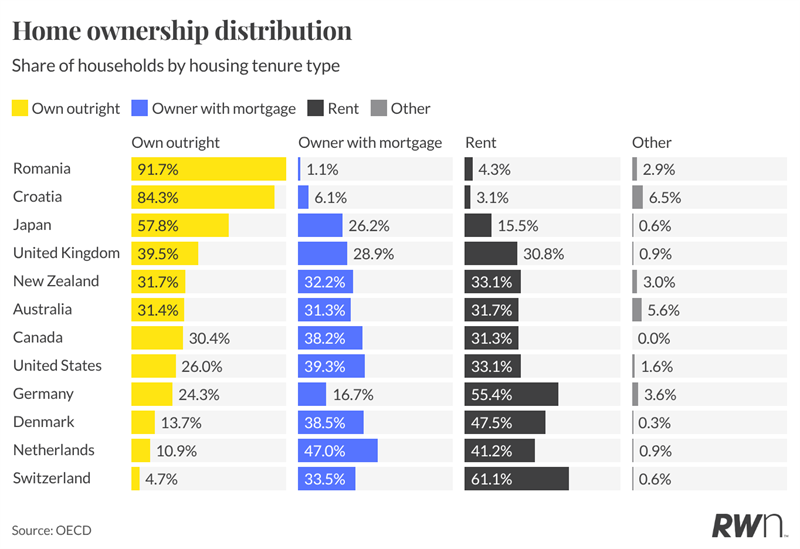
Housing around the world
Among OECD countries, Romania (91.7 per cent) and Croatia (84.3 per cent) have the highest share of households who own outright. But their high rates trace back to a single policy event: the mass transfer of state housing stock to sitting tenants in the early 1990s. People own their homes free and clear, which delivers real security of tenure.
The downside is that the rental market never developed depth, so labour mobility is limited (it’s hard to move for a job when renting is expensive and scarce), housing quality is uneven, and property is often illiquid or difficult to renovate. The geopolitical context these countries found themselves in is hardly easy to replicate in Australia today.
On the other side of the spectrum sits the most direct alternative to the Australian Dream. Western European countries such as Switzerland, the Netherlands, Denmark and Germany have built housing systems around renting as a legitimate, stable long-term choice, not a stepping stone to ownership.
In Switzerland, where around 61.1 per cent of households rent, and Germany, at 55.4 per cent, renting is the dominant tenure. This reflects strong tenant protection laws, professionally managed rental stock, historically rent-controlled urban housing, and a deliberate post-war policy decision not to subsidise owner-occupation to the same extent as countries like the UK or the US.
Japan offers the most radical alternative. Residential buildings depreciate to near zero within 30 years, stripping housing of its wealth-storage function entirely. Because houses depreciate rather than appreciate, Japan builds continuously.
In Tokyo, more housing permits are issued annually than in the entire state of California, yet rents have remained broadly flat for decades. Without expectations of capital gains, there is far less political pressure to restrict supply.
Australia sits in the middle alongside New Zealand, Canada, the UK, and the US. These markets are the “homeownership dream” cluster, yet within that shared dream are differences worth learning from.
The US is the most instructive divergence. While Australia’s outright ownership rate has drifted downward, America’s has climbed steadily from 21.5 to 26 per cent over the same period.
Its 30-year fixed-rate mortgage locks borrowers into a rate for the life of their loan, converting debt into equity on a predictable schedule. Australia’s variable-rate mortgage culture works in reverse: every rate rise hits borrowers immediately, and low rates have historically encouraged equity extraction rather than paydown.
The United Kingdom offers a different lesson. Rather than building a strong private rental market, Britain bifurcated: you either owned your home or were housed by the state. As Right to Buy policies sold off council stock from the 1980s onward and ownership became unaffordable for a new generation, there was no adequate private rental sector to absorb the overflow. The UK’s housing crisis is, in part, the cost of never having built one.
Canada and New Zealand most closely mirror Australia: high mortgage dependence, minimal social housing, and a private rental sector that expanded not by design but by default.
Policy matters
The Australian Dream is not dead. But it has been quietly privatised.
Incentives like first-home buyer grants and Help-to-Buy schemes temporarily boost individual access but inflate prices, benefiting existing owners and undermining their own goals.
The single most transferable lesson from the OECD data is that countries with functioning housing systems, whether ownership-based like the US or rental-based like Germany, built them through deliberate, tenure-neutral policy sustained over time.
The idea of a quarter-acre block may have shrunk, but the dream of a home you can call your own does not have to.