





















I’ve talked a lot about Australian property prices but just how do they compare with overseas markets? I know every market is different but a comparison does bring some perspective.
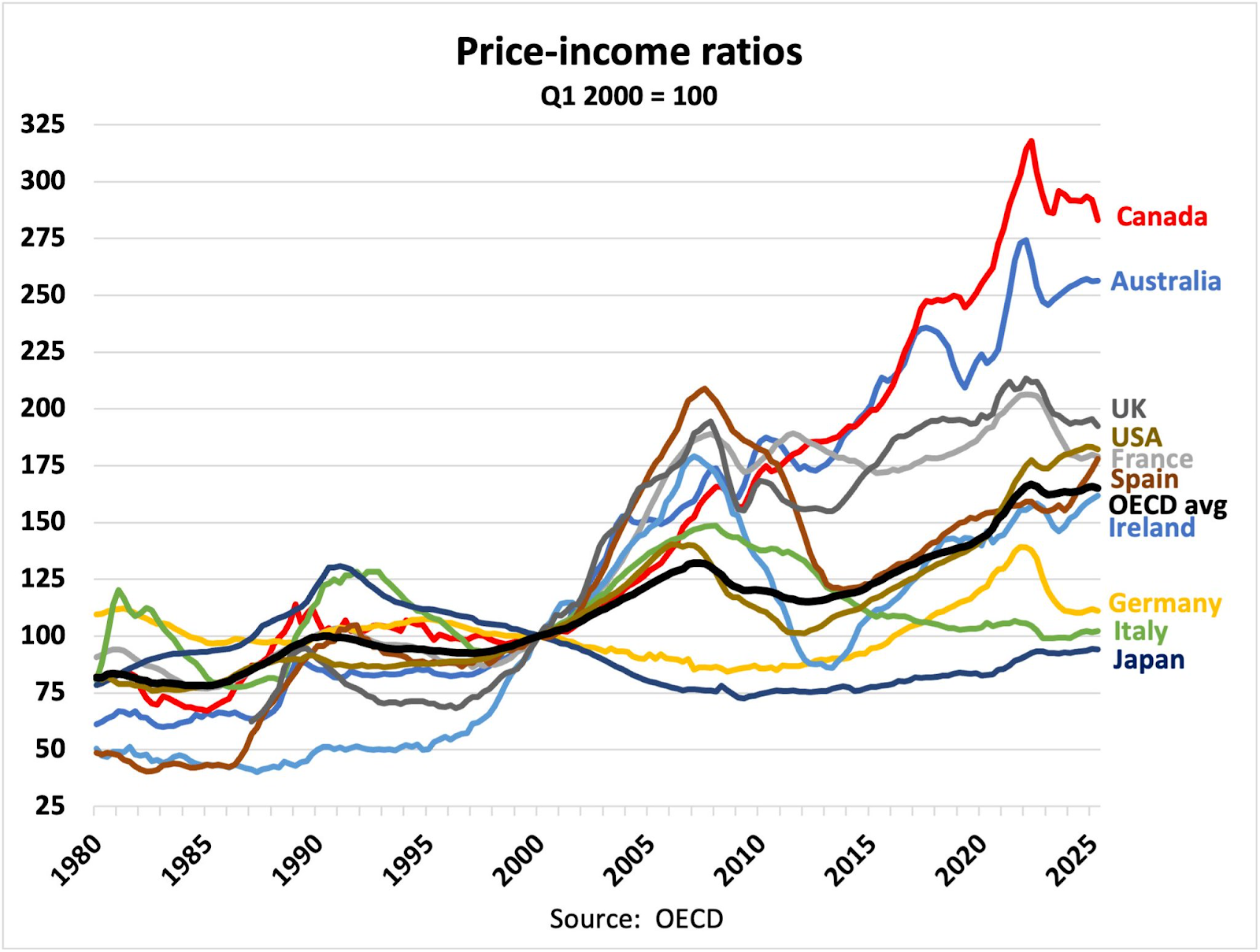
The below chart from the Organisation for Economic Co-operation and Development (OECD) shows that from an affordability perspective, Australian property is expensive. The OECD does this by comparing income/wages to the cost of buying a property.
In the 20 years up until the year 2000, Australian property, from an affordability basis, was tracking pretty well in line with the rest of the world. But in the last 25 years, Australia and Canada have seen a surge in values, and incomes haven’t kept up.
It is harder in both countries for buyers to have the necessary income to buy a property.
In the big smoke
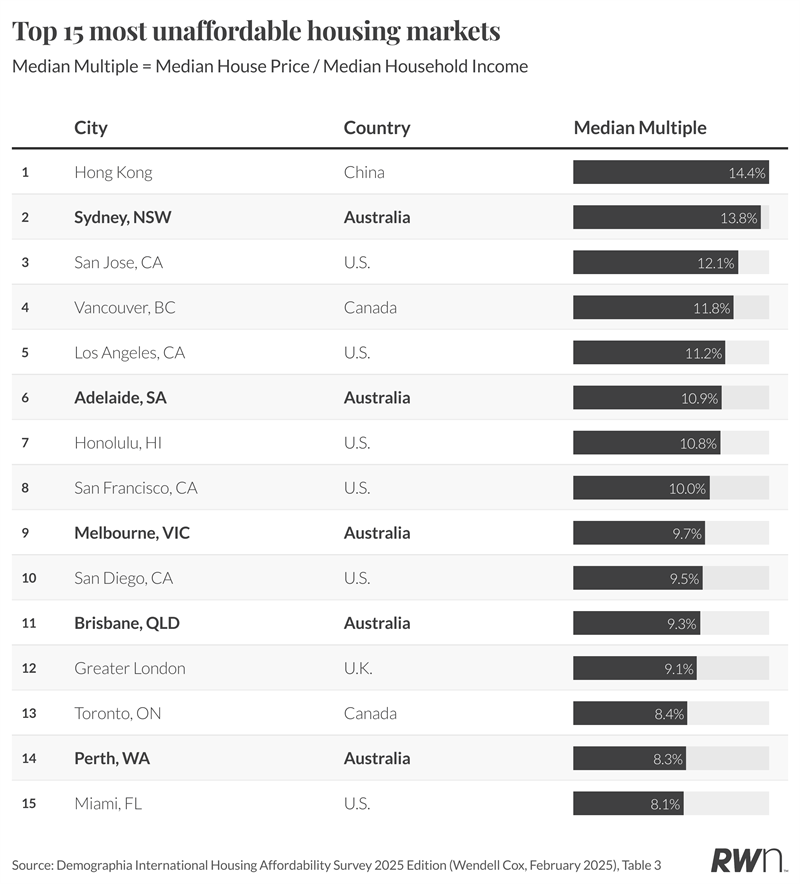
On a city basis, property giant Ray White has produced a report showing Sydney remains one of the most expensive housing markets on the planet, but the bigger story from this year’s Demographia International Housing Affordability Report may be what’s happening further south.
Adelaide, long regarded as Australia’s “affordable capital”, is now the second least affordable city in the country, with housing costs rising far faster than local incomes.
The latest report continues to rank Sydney as the world’s second least affordable housing market, behind only Hong Kong. Sydney’s median house price is now 13.8 times the median household income – what Demographia calls “impossibly unaffordable”.
Adelaide’s median multiple has climbed to 10.9, pushing it past Melbourne (9.7) and Brisbane (9.3).
Planet’s most unaffordable
In global terms, all five of Australia’s major cities fall into the report’s highest category of ‘unaffordable’. Surprisingly, Perth – where prices have risen rapidly over the past four years – is now the most affordable of the group, sitting at 8.3 times income.
High wages go some way to explaining why Perth remains relatively more affordable, although it is still well above the international benchmark of 3.0, which Demographia considers “affordable”.
The report highlights a sharp turnaround for Adelaide. Just a few years ago, the city’s housing market was among the most accessible in the country. But strong price growth has pushed affordability to record lows. Prices have risen by 9.1 per cent, outpacing both Melbourne and Sydney. Australia’s national median multiple is 9.7 – worse than Canada (5.4), the UK (5.6) or the US (4.8).
On this measure, Australia’s housing is less affordable than virtually any other high-income nation.
Supply and demand
While limits on urban expansion play a role, local resistance to higher density housing is likely a more pressing constraint as is the desire of Australians for large homes. At the same time, a sharp rise in construction costs since the pandemic has made new projects harder to deliver, compounding the affordability challenge.
The affordability squeeze is unlikely to improve soon. September data shows national house prices are up 8.9 per cent over the year – and are on track to reach double-digit annual growth by December.
Any further Reserve Bank rate cuts will fuel stronger growth, while generous first-home buyer incentives are driving sharp gains at the cheaper end of the market. New housing supply continues to lag well behind target, with little improvement over the past year.