




















Most would agree that the Australian property market has been nothing short of turbulent in the past few years, so much so that Melbourne has found itself in an unusual position …
Once the second-highest city in terms of median dwelling values, it has since been relegated to sixth place – overtaken by all other capitals except Darwin and Hobart.
So what exactly is driving this shift? Let’s break down the biggest influencing factors according to the latest CoreLogic data, and what it means for both buyers and sellers. At the national level, home values have increased for 19 consecutive months, with a 0.5 per cent rise in August. But the pace of growth is slowing. For Melbourne, it looks to be grinding to a halt. While other capitals like Perth and Brisbane have surged ahead with impressive gains, Melbourne’s values have only increased by 19.8 per cent over the past five years – eye-wateringly lower than Perth’s 76.4 per cent and Brisbane’s 71.5 per cent surge over the same period.
Melbourne’s lower growth can be attributed to a few different things. There’s the inevitable slower recovery from the pandemic and tighter affordability constraints compared to other cities. While Perth and Adelaide have become more attractive to buyers due to their relative affordability, Melbourne’s housing prices have remained more stagnant, failing to keep up with the pace seen in mid-sized capitals.
Affordability and migration trends
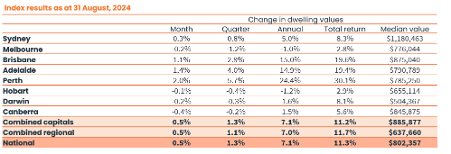
Affordability has long been an issue across the Melbourne property market, but buyers could be seeing some positive signs on the horizon. The gap between Sydney and Melbourne’s median dwelling values is now at its highest since 1999, with Sydney’s median sitting at $1.18 million compared to Melbourne’s $776,000 – a 52.1 per cent differential. While Sydney will hold onto its mantle of priciest capital for the foreseeable future, Melbourne has struggled to maintain its competitive edge in attracting new residents, particularly after the pandemic-induced exodus.
Net interstate migration patterns during the pandemic saw droves of residents flee Melbourne in search of more affordable housing and better lifestyle options, with Brisbane, Perth and Adelaide high on their shopping list. These capitals saw positive migration trends for the first time in years, whereas Melbourne experienced a population decline. Although migration patterns are slowly starting to stabilise, the damage to Melbourne’s property market growth is clear for all to see.
Perth and Adelaide on the rise
Perhaps the most striking development has been just how quickly Perth and Adelaide have climbed the housing-value rankings. For the first time in nearly a decade, Perth’s median dwelling value ($785,250) is higher than Melbourne’s. Adelaide is doing even better at $790,800, surpassing Melbourne for the first time in CoreLogic’s 40-year median dwelling
value series.
So what’s behind all this? Yes, part of it is affordability – Perth and Adelaide have historically been more affordable markets compared to the glitz and glamour of Melbourne, and this has attracted buyers who want more bang for their buck. But both cities have also experienced more consistent growth since the pandemic, while Melbourne's recovery has been sluggish. As demand in the more affordable capitals grows, so too do their property values.
Densification and other impacting factors
Another influence on Melbourne’s falling median value is the composition of its housing stock. Melbourne has undergone major densification in recent years, with around 33 per cent of its housing stock now falling within the multi-unit sector (i.e. apartments and townhouses). In contrast, Perth and Adelaide have a much lower proportion of multi-unit dwellings, at just
16 per cent each.
This issue of housing composition is important because multi-unit dwellings tend to have lower values than free-standing houses. As Melbourne’s housing market shifts towards higher-density living, its median dwelling value is naturally pulled down. It’s a shift that hasn’t been as pronounced in Perth and Adelaide, where the focus has remained on lower-density housing.
What’s next for Melbourne’s property market?
While their position in the property-market hierarchy has certainly changed, it’s not all bad news for Victorians. True, it might no longer hold the second-highest median dwelling value in the country, but the city itself still has much to offer. Its diverse housing stock means there are opportunities for buyers, especially in more affordable areas. As Australia continues to recover from the pandemic, migration trends could also once again favour Melbourne.
For buyers looking to enter the market, Melbourne’s lower-than-average growth rates and increasing supply of home units could present an opportunity. With more listings hitting the market – especially compared to Perth and Adelaide – buyers might find better deals and less competition in the Victorian capital. For sellers, though, it might mean adjusting your expectations and accepting that the rapid growth seen in other parts of the country might not be mirrored in Melbourne for some time.
Melbourne’s fall from grace in the housing-value rankings might seem surprising at first, but it’s the result of a combination of moving forces: slower growth, lack of affordability, migration trends and a shift towards higher-density living. While cities Perth and Adelaide have surged ahead for now, Melbourne’s more subdued growth brings with it challenges as well as opportunities – depending, of course, on which side of the market you’re on.