





















It has never been easier to invest overseas, either directly or through ETFs and managed funds. Those who have taken advantage of this access have been big winners when it comes to performance.
According to investment research group Rainmaker Information, international equities large cap (large international listed shares) was the top-performing managed fund asset class in FY 2024–25, delivering a median return of 16.6 per cent for the financial year.
This was followed by emerging markets (15.2 per cent), Australian large cap (13.3 per cent), Australian small cap (13.1 per cent), and Australian income-focused funds (12.2 per cent).
Global gaming and resources
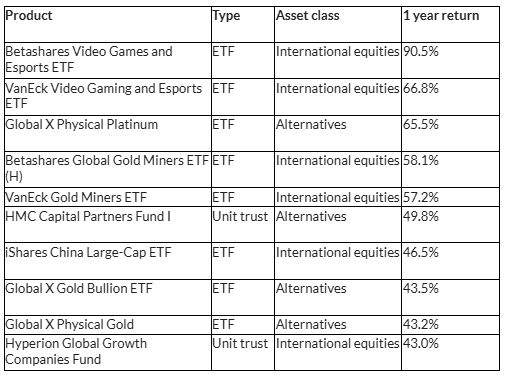
When it came to the best performing individual investment products for the last financial year, video gaming and resources topped the list but all their portfolios were heavily skewed to international exposure.
The top-performing products over the 12-month period were the BetaShares Video Games and Esports ETF, which delivered a 90.5 per cent return, followed by the VanEck Video Gaming and Esports ETF with a 66.8 per cent return.
Commodity ETFs also featured prominently, with the Global X Physical Platinum ETF returning 65.5 per cent, the BetaShares Global Gold Miners ETF (Hedged) up 58.2 per cent, and the VanEck Gold Miners ETF returning 57.2 per cent.
International exposure
By exposing themselves to overseas shares, some beyond the obvious popular picks, Australian investors are able to diversify their portfolios with a range of different companies in innovative, growing sectors. These are larger markets with bigger companies and potentially, much bigger gains. Putting all your eggs in the Aussie share basket means you may be missing out.
This is why I say every investment portfolio should include some overseas share exposure. How much will depend on your individual risk profile. And that’s important. If market wobbles keep you up at night, investing overseas where there can be more volatility may not be for you.
That said, investing internationally can also help to spread risk because investors are not solely reliant on the performance of the Australian economy or our property market, and have access to global growth opportunities, including in sectors or regions with more rapid expansion.
Before investing internationally, you’ll need to do your homework. Get good financial advise and do your research into companies. And as always, don’t put all your eggs in one basket, including the international one. Diversification is key.